Table of Contents
Introduction
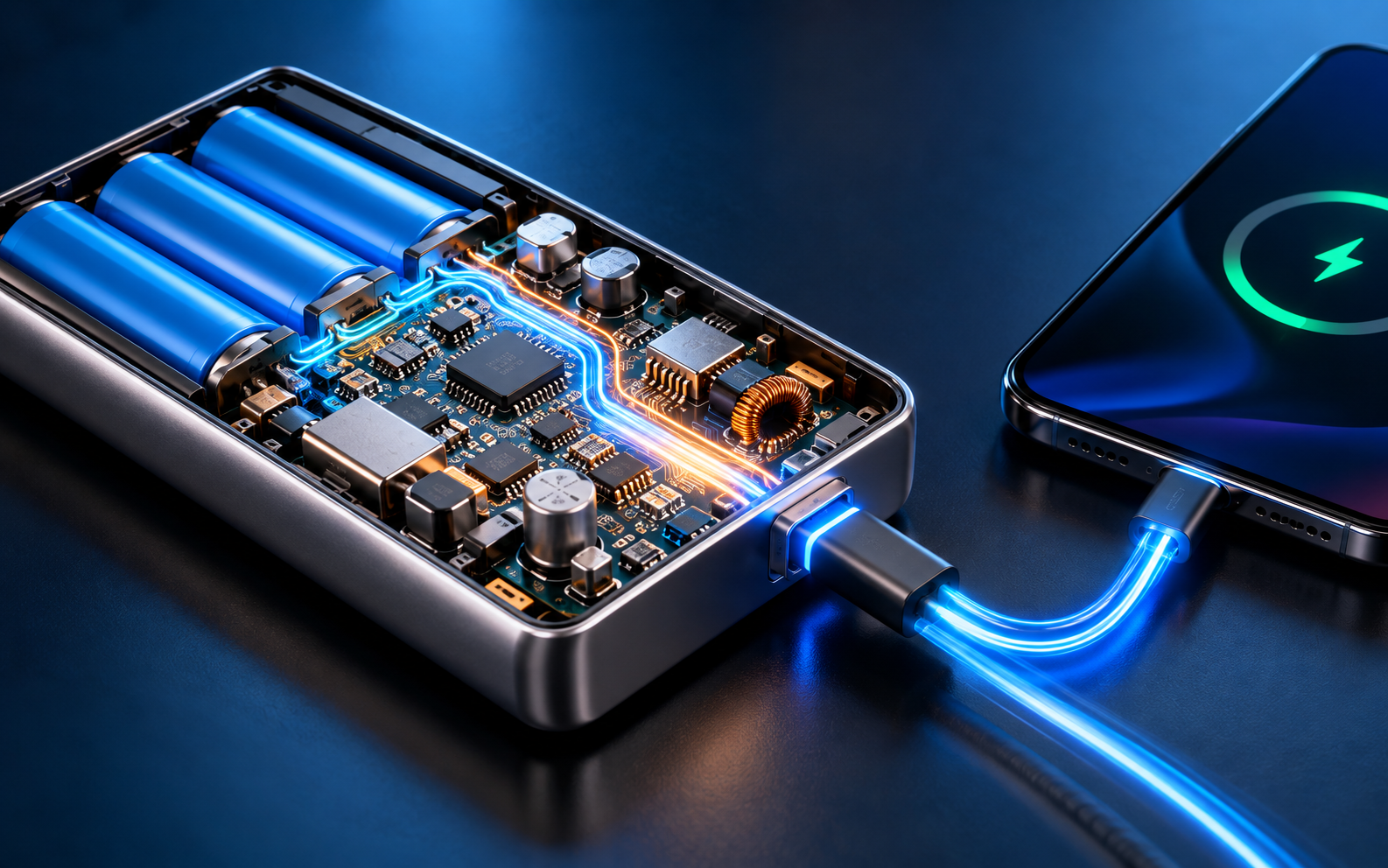
Power banks are not chosen just for storage capacity anymore—how fast they charge your devices matters just as much, sometimes even more. This speed comes from a key component: the power bank fast charging module.
Simply put, the power bank fast charging module is the internal circuit that controls and accelerates power flow between the power bank and your device by safely handling higher voltage and current levels.
In this guide, you will learn how this module works, what parts it contains, which fast charging protocols it supports, how to choose the right module, and how to fix common problems—everything you need to understand this small but powerful piece of tech.
What is a power bank fast charging module?
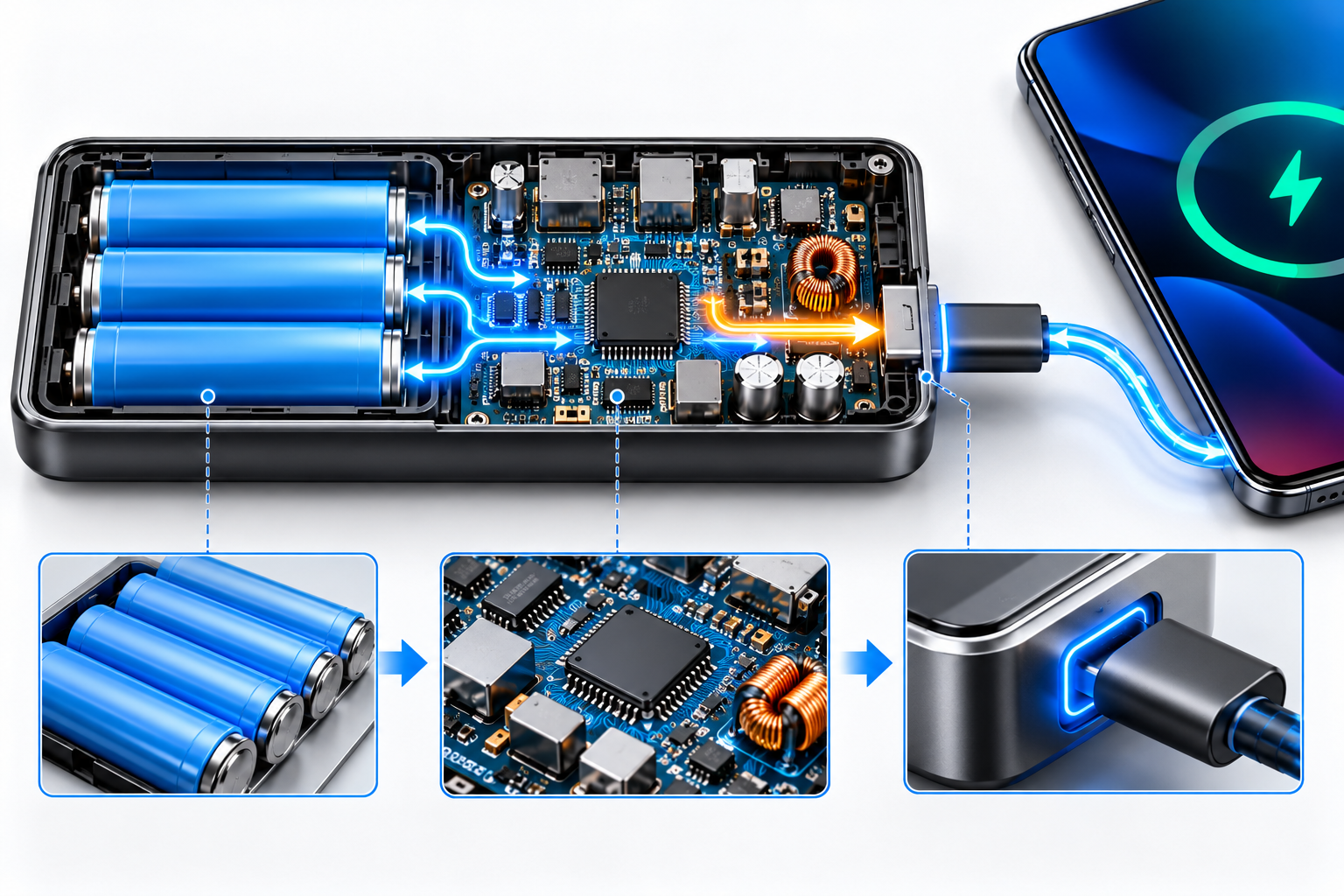
The fast-charging module is a circuit board inside the power bank that controls how quickly your devices charge. Instead of always providing a slow, constant charge, it monitors how much charge your device can handle and increases the voltage and current when necessary.
This module is placed between the battery cells and the output port inside the power bank. It monitors charging conditions and adjusts power as needed, rather than delivering a constant current.
Normal charging vs. fast charging module:
| Aspect | Standard Charging | Fast Charging Module |
|---|---|---|
| Output | Fixed 5V/1A or 5V/2A | Variable, up to 65W+ |
| Communication | None | Handshake protocol with device |
| Charging Time | Slow | Significantly faster |
| Heat Management | Basic | Active thermal control |
How Does a Power Bank Fast Charging Module Work?
Protocol Negotiation
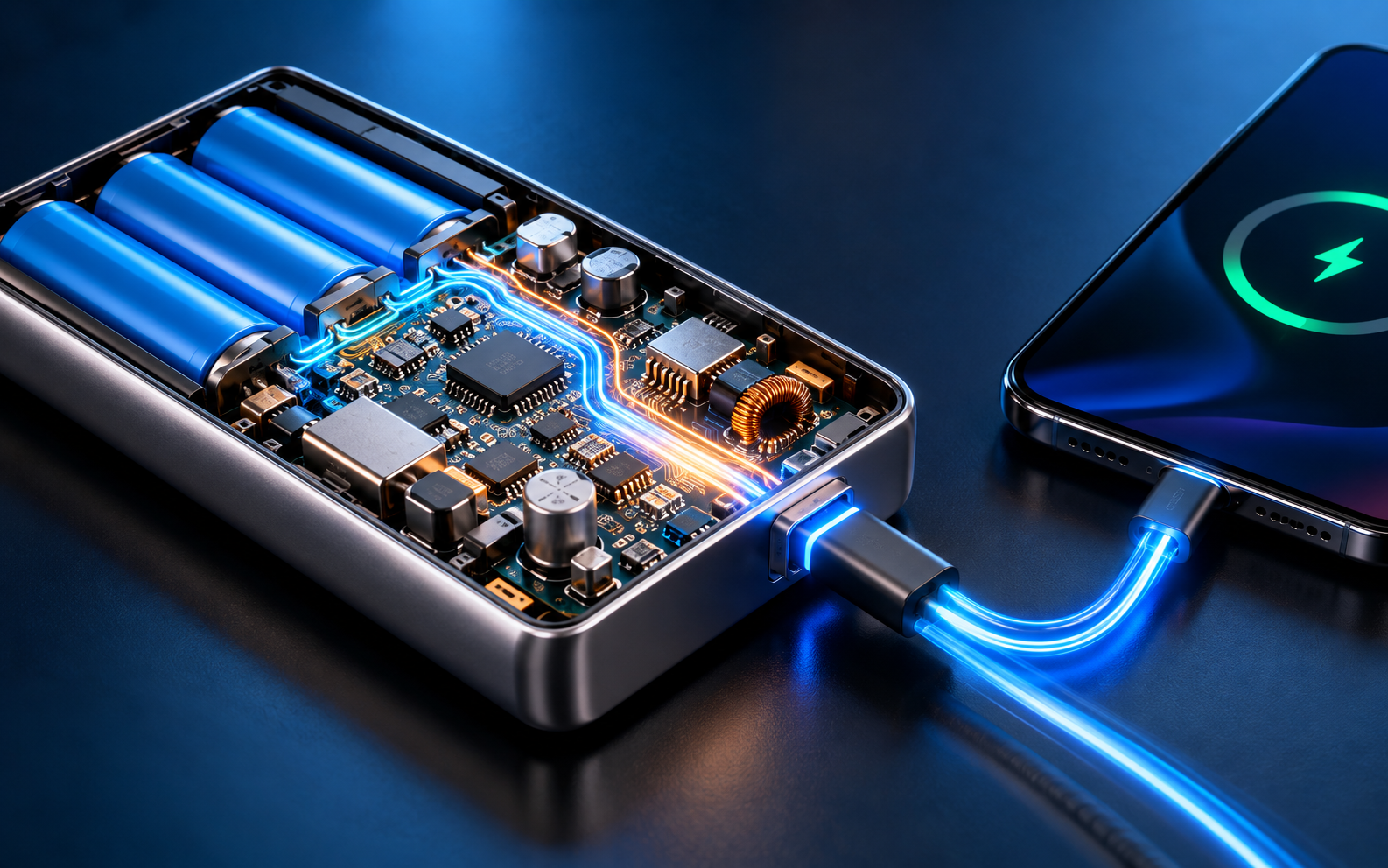
When you plug in a device, the power bank fast charging module and the device’s charging chip perform a quick “handshake.” During this exchange, they identify which fast-charging protocol (such as PD or QC) they both support and agree on safe voltage and current values.
Voltage and Current Regulation
Once the negotiation is complete, the module precisely regulates how much voltage and current flow to the device. This isn’t a one-time setting—it adjusts continuously as the battery fills and gradually reduces power near full charge to avoid stressing the battery.
The Role of the Buck/Boost Converter
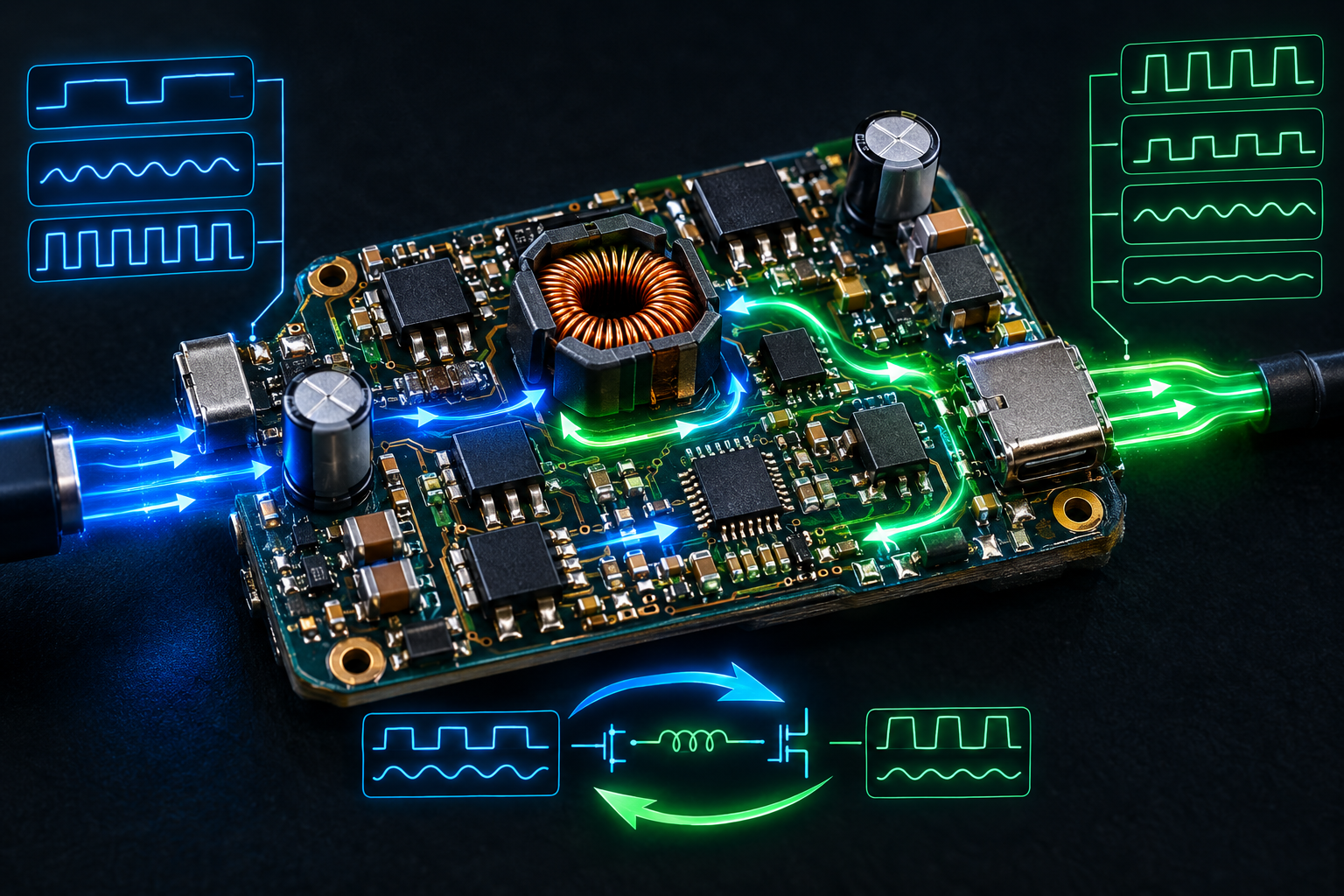
A buck-boost converter inside the module steps the voltage up or down as needed. This lets the same fast charging power bank module support multiple output levels (such as 5V, 9V, 12V, or 20V) depending on the connected device’s needs.
Safety Controls from the BMS (Battery Management System)
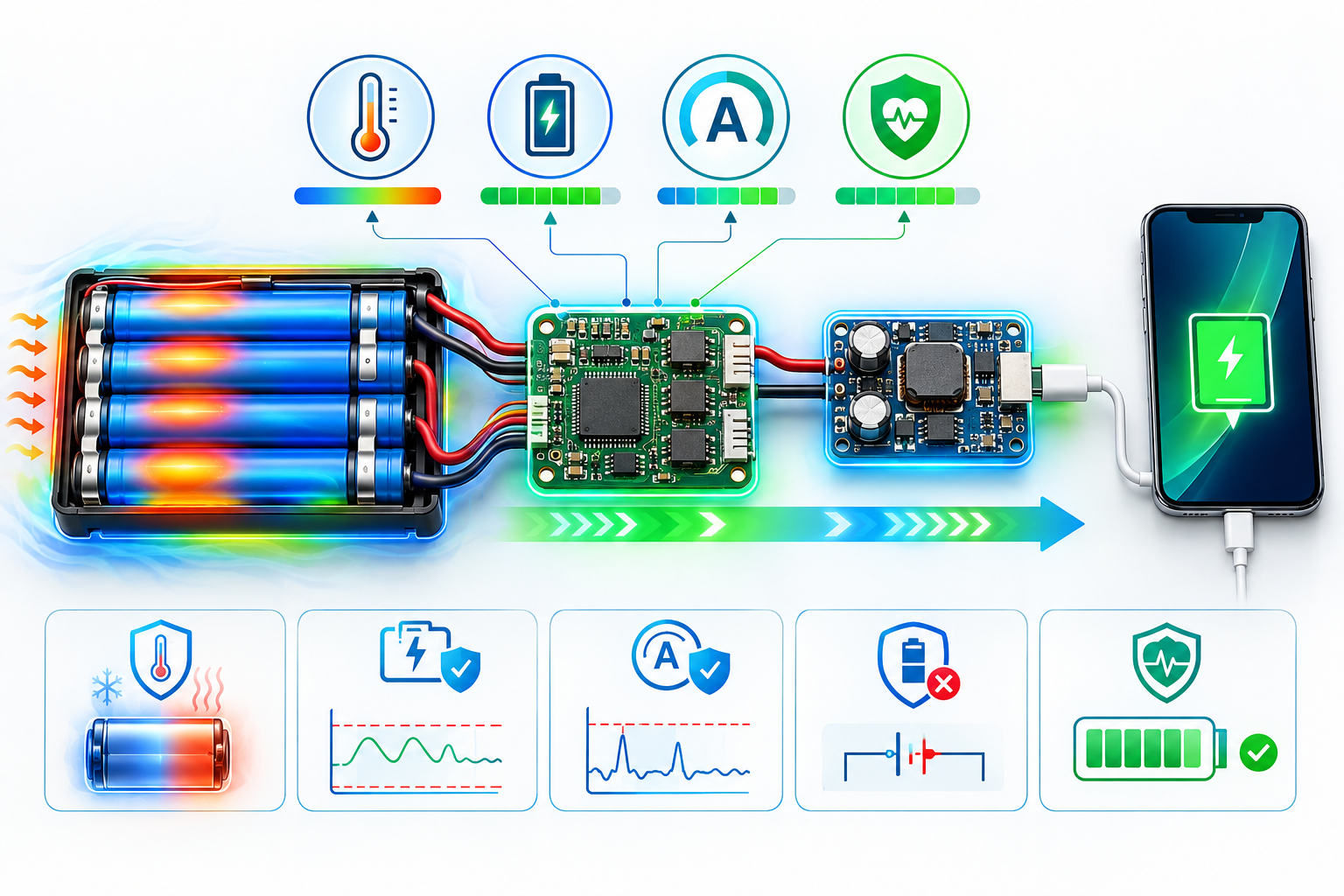
The battery management system works with the fast charging module to monitor cell health, temperature, and charge cycles. It acts as a safety layer, cutting off or limiting power if it detects abnormal voltage, current, or heat levels.
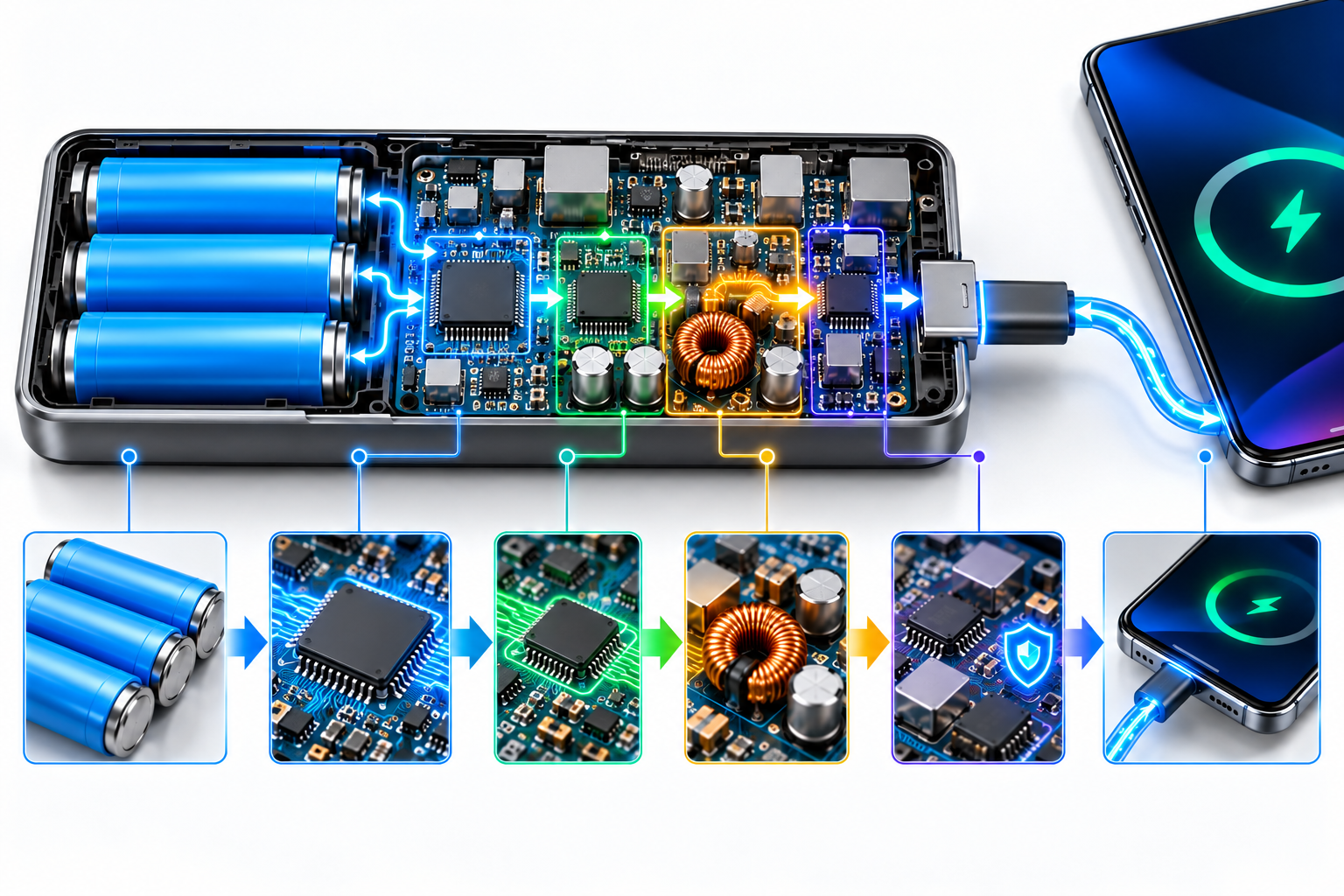
Main Parts of a Fast Charging Module
- Charging IC/Controller — The “brain” that manages protocol detection and power regulation
Boost Converter - Circuit — Increases voltage to meet fast charging requirements
- Protocol Chip — Provides compatibility with standards such as PD, QC, or VOOC
- MOSFETs — Act as electronic switches that control current flow with minimal energy loss
- Protection Circuit — Protects against over-voltage, over-current, short-circuit, and overheating conditions
All of these parts work together, and even one weak component can affect the module’s performance and safety.
Supported Fast Charging Protocols
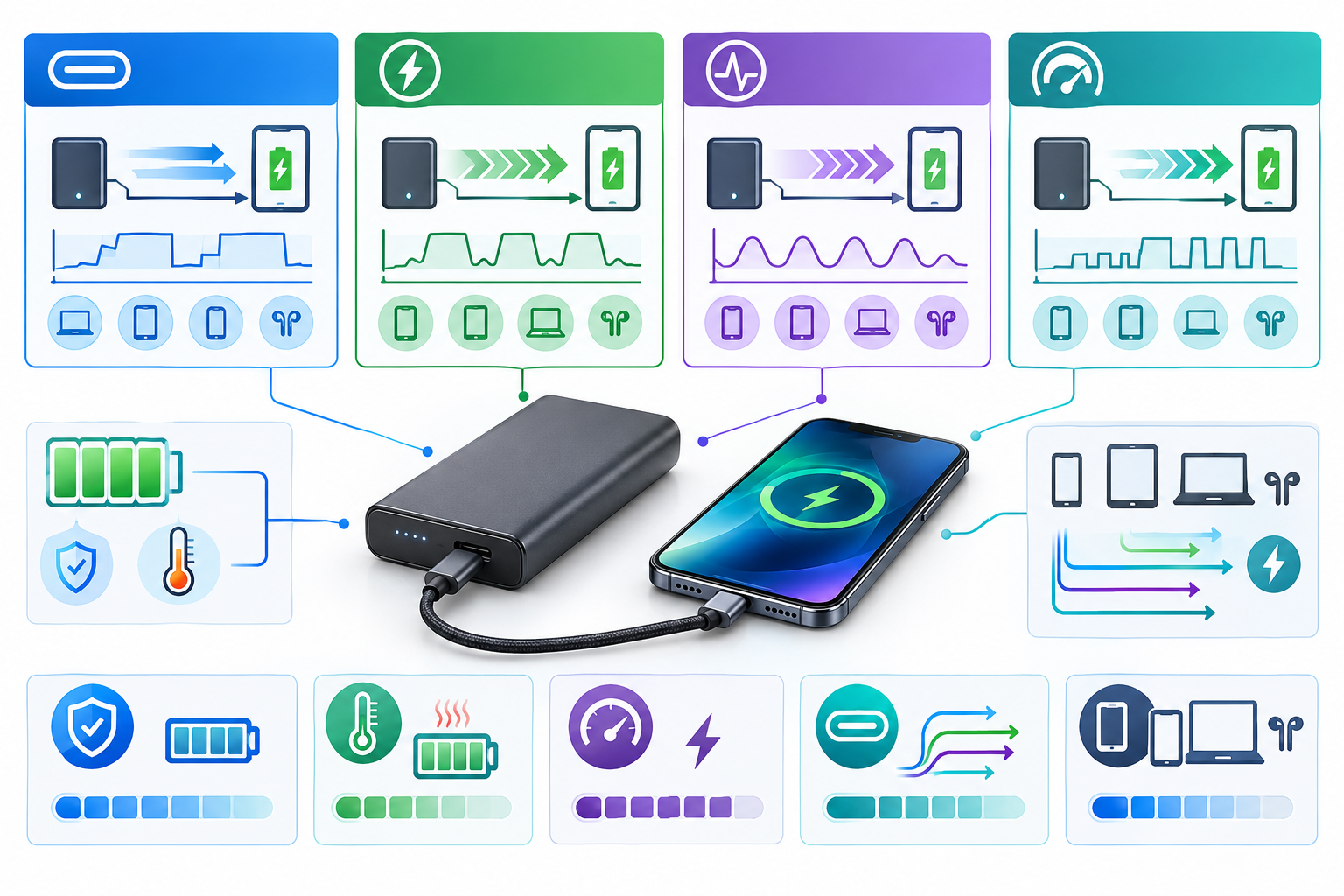
USB Power Delivery (PD)
A universal standard used in iPhones, iPads, laptops, and many Android devices. USB-PD scales output to meet the device’s needs and is currently the most widely adopted fast-charging protocol.
Qualcomm Quick Charge (QC 3.0/4.0)
Common in Android phones with Snapdragon chipsets. QC allows for more voltage steps for faster top-ups than standard charging.
PPS (Programmable Power Supply)
An extension of USB-PD found in many Samsung Galaxy devices, allowing for finer voltage adjustments in smaller increments for more accurate, safer charging.
FCP, SCP, AFC, VOOC/SuperVOOC
These are brand-specific protocols—FCP and SCP from Huawei, AFC from Samsung, and VOOC/SuperVOOC from OPPO and OnePlus. Devices using them usually require a matching charger or power bank to unlock the full speed.
Protocol Comparison Table:
| Protocol | Max Power (approx.) | Compatible Devices |
|---|---|---|
| USB-PD | Up to 100W | iPhones, iPads, laptops, many Androids |
| QC 3.0/4.0 | Up to 27W | Snapdragon-based Android phones |
| PPS | Up to 45W | Samsung Galaxy series |
| VOOC/SuperVOOC | Up to 150W | OPPO, OnePlus, Realme |
| AFC | Up to 15W | Samsung (older models) |
Types of Power Bank Fast Charging Modules
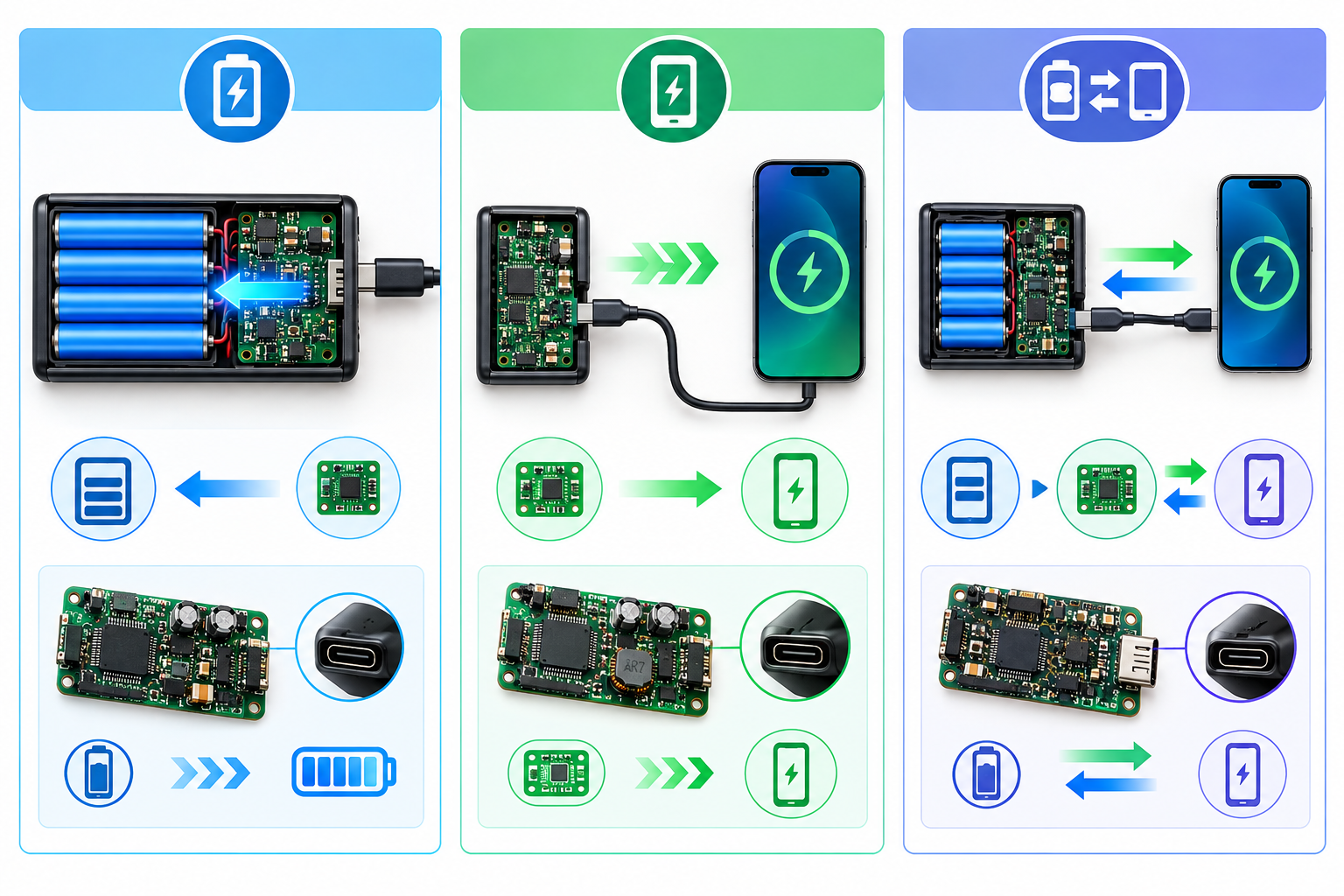
- Input-Only Modules — Let the power bank charge faster, but the output remains standard.
- Output-Only Modules — Allow connected devices to charge faster, but the power bank itself charges more slowly.Two-Way Fast Charging
- Modules — Support fast charging in both directions, meaning the power bank charges faster and also charges your device faster.
Common Wattage Tiers: 18W modules are perfect for basic smartphones, 22.5W and 30W handle most modern flagships, while 45W and 65W modules are designed for larger devices like tablets and laptops.
Benefits of using a fast charging module
- Faster charging time — Charging time is significantly reduced compared to standard output
- Improved efficiency and reduced heat — Smart regulation reduces energy waste and thermal stress
- Multi-device compatibility — Allows you to charge different phone brands and protocols from a single power bank
- Improved safety — Built-in protections reduce the risk of overheating or battery damage
How to Choose the Right Fast Charging Module
- Protocol Compatibility — Match the module’s supported standards to your device’s charging protocol.
- Output Wattage and Voltage Range — Higher wattage only helps if your device can use it.
- Efficiency and Heat Management — Better-designed modules dissipate less energy as heat.
- Safety Certification — Look for CE, RoHS, and FCC markings as baseline safety indicators.
Size and PCB - Compatibility — Important for anyone building or repairing a power bank, as the module must physically fit.
- Battery Type — Li-ion and Li-polymer cells have different charging tolerances, which impact module design.
Fast Charging Module for DIY Power Bank Projects
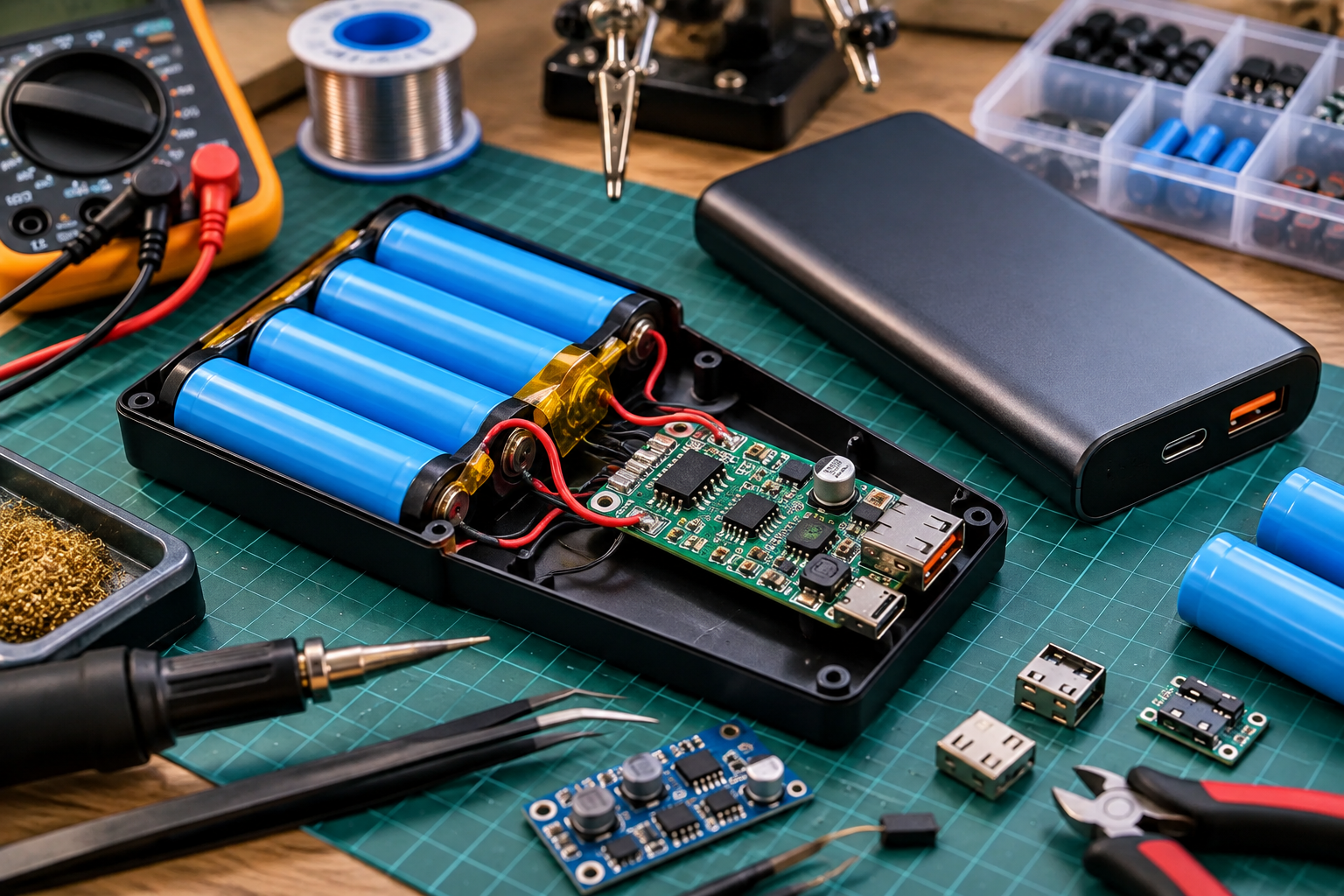
For those building custom power banks, the fast-charging module is typically connected between the battery pack and the output port, along with a BMS.
Common mistakes to avoid:
- Omitting BMS integration, risking overcharging
- Using different wattages between the module and battery cells
- Poor soldering leads to loose or insecure connections
Safety precautions: Always use cells with matching capacity and discharge rate, properly insulate connections, and test the circuit at a low load before full use.
Common Problems and How to Fix Them
Fast charging isn’t working — This often occurs because the cable isn’t suitable for fast charging or there’s a problem with the device/module protocol.
Module overheating — This can be caused by poor ventilation, faulty components, or constant high-load use.
Device compatibility issues — This occurs when the module supports a different protocol than the device expects.
Charging is slow despite the module being installed — Check that the cable, port, or device battery health is the real problem, not the module itself.
Fast Charging Module vs Standard Charging Board
| Factor | Fast Charging Module | Standard Charging Board |
|---|---|---|
| Speed | High (protocol-based) | Low (fixed output) |
| Cost | Higher | Lower |
| Safety Features | Advanced (multi-layer protection) | Basic |
| Compatibility | Multiple protocols/devices | Limited, single-rate output |
Frequently Asked Questions
Q1: Do all power banks have a fast-charging module?
No. Basic, budget power banks often lack a dedicated fast-charging module and offer only a standard 5V output. Check the wattage specification (18W or higher) in the product listing to confirm fast-charging support.
Q2:Can a fast charging power bank module damage my phone?
A properly certified module is designed to communicate safely with your device and will not exceed safe voltage or current levels. Damage usually comes from uncertified, poorly made power banks that lack safety protection.
Q3: Are more watts always better?
Not necessarily. Your device can only draw as much power as its charging chip allows. A 65W power bank, limited to 20W, won’t charge a phone any faster than a properly matched 20-30W module
Conclusion
A power bank fast-charging module may be small, but it drives fast, safe charging. From protocol negotiation to voltage regulation and built-in safety features, understanding how it works helps you make a smart buying decision—whether you’re choosing a ready-made power bank or building one yourself.
Are you looking for a power bank that delivers fast charging effectively? Check out our full range of power bank reviews and buying guides on PhoneFight to find the best match for your device.